
Your lab equipment passes every factory test, but once it is installed in your Richardson facility it freezes, reboots, or spits out noisy data at the worst possible moment. The building is new, your IT team is confident in the network, and every vendor insists their gear is fine. Yet validation runs fail for no obvious reason, and small “ghost” issues keep eating up staff time and credibility.
If that sounds familiar, you are not alone. Across the Telecom Corridor and research spaces around Richardson, we see high-tech labs fighting what looks like bad luck or bad hardware, when the real problem sits deeper in the building’s electrical system. Electromagnetic interference (EMI) and dirty power do not show up on a simple outlet tester, but they can quietly undermine sensitive instruments, imaging systems, analytical gear, and critical IT infrastructure.
At ElectricMan, our team is led by a Master Electrician with over 35 years of commercial and industrial experience in the Dallas area, and we have been called into more than a few “mystery” lab problems in Richardson that passed inspection but still behaved badly. In this guide, we want to walk through how EMI and grounding really work in labs, why code compliance is only the starting point, and what practical grounding and clean power strategies can stabilize your high-tech environment.
Why Code-Compliant Power Still Causes Problems in High-Tech Labs
Many facility and lab managers assume that if a building meets National Electrical Code (NEC) requirements, it should provide reliable power for sensitive equipment. While code compliance is essential for safety, it is not designed to deliver the power quality needed for research labs and high-tech environments.
The NEC focuses on protecting people and property through proper conductor sizing, overcurrent protection, grounding, and fault protection. It does not address performance issues such as:
- Electrical noise
- Voltage fluctuations
- Harmonic distortion
- Grounding inconsistencies
- Shared neutral interference
In many Richardson laboratories, electrical panels serve lab equipment alongside office or building loads. While this may meet code, changing electrical demands can introduce power disturbances that affect sensitive instruments, leading to:
- Equipment resets
- Calibration drift
- Inaccurate readings
- Data errors
At ElectricMan, we evaluate electrical systems for both safety and performance. By identifying power quality, grounding, and load distribution issues, we help Richardson laboratories create a more stable electrical environment for precision equipment and critical operations.
How EMI Sneaks Into Your Lab Power and Data Paths
Electromagnetic interference (EMI) is a common cause of power quality issues in laboratories. It can travel through electrical conductors (conducted EMI) or spread through the air as electromagnetic fields (radiated EMI). Both can interfere with sensitive equipment without causing an obvious electrical failure.
Common EMI sources in Richardson commercial buildings include:
- Variable frequency drives (VFDs)
- Elevator motors
- LED lighting drivers
- Switching power supplies
- Server power equipment
- Large office equipment
This electrical noise can spread through shared branch circuits, neutrals, and conduit runs. When lab equipment shares electrical infrastructure with HVAC systems, office areas, or other high-demand loads, voltage fluctuations and high-frequency noise can affect sensitive instruments.
Poor cable routing can also create problems. Running high-voltage power cables alongside low-voltage data wiring may introduce interference that results in:
- Data errors
- Measurement drift
- Equipment resets
- Communication issues
- Unstable instrument performance
At ElectricMan, we identify EMI sources, evaluate circuit layouts, and recommend electrical improvements that help reduce interference and improve power quality for Richardson laboratories and research facilities.
Grounding and Bonding Choices That Make or Break Lab Performance
Grounding and bonding are often treated as box-checking items. Connect the green wire, land it on the bar, and move on. In a high-tech lab, that approach leaves performance on the table. Grounding and bonding decisions have a direct impact on the electrical reference your instruments use to interpret signals and on how noise currents flow through the building.
Grounding provides a return path for fault current and a reference point for the system. Bonding ties metal parts together so exposed surfaces stay at the same potential. In a perfect world, every grounded point in your lab would sit at exactly the same potential, so your instruments see a rock-solid reference. In reality, small voltage differences exist between different points on the grounding network, especially when high currents and harmonics are present.
Those small differences can create ground loops. A ground loop is a situation where multiple grounding paths exist between pieces of equipment. This allows circulating currents to flow in what should be quiet reference conductors. For a precision instrument that is looking for microvolts or microamps of signal, a few millivolts of ground noise can be enough to look like a real reading or to confuse internal electronics.
We also see issues when clean and dirty equipment share the same ground bar or conductor path. Heavy switching loads, welding equipment, or large drives can dump noise current into the same grounding network that delicate analytical instruments rely on. On paper, everything is properly bonded for safety. In practice, the noisy return currents raise and lower the local ground reference that instruments use, which shows up as drift, spikes, or communication errors.
Our safety-driven work with panel upgrades, surge protection, and system inspections often reveals these hidden problems. When we rework panels, separate noisy loads, and adjust how grounding and bonding are arranged, labs can see a noticeable improvement in stability. The change is not magic. It is simply giving high-tech equipment a quieter, more stable reference plane to live on.
Designing Clean Power for Richardson’s High-Tech Labs
Once you understand how EMI and grounding issues arise, the design principles for clean power in labs start to look straightforward. The goal is to separate noisy and sensitive loads, control how currents flow, and provide a stable reference for instruments. The exact solution for a given Richardson lab depends on the building and equipment, but some patterns show up again and again.
A common strategy is to separate clean lab loads from dirty building loads at the panel level. That can mean giving the lab its own dedicated panel or subpanel, fed from the main service through carefully planned feeders. Noisy drives, large mechanical loads, kitchen areas, and other high-distortion equipment are moved to different panels. This limits how much their harmonics and switching noise can ride into lab circuits that power sensitive devices.
Isolation transformers are another powerful tool. An isolation transformer feeding a clean power panel can block some common-mode noise and help establish a more controlled reference for the lab circuits downstream. Paired with dedicated neutrals and dedicated equipment grounding conductors for sensitive circuits, this reduces shared impedance and the chances that a surge of current elsewhere in the building will show up as a disturbance at a lab bench.
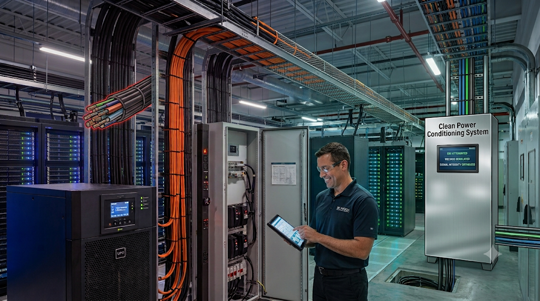
Physical routing matters as much as the one-line diagram. When we design or retrofit for labs, we pay attention to how conduits, cable trays, and raceways run through the space. Keeping clean power feeders away from large, noisy feeders and avoiding long parallel runs with data cabling reduces both conducted and radiated coupling. In some cases, a modest change in routing can have a larger impact than any plug-in filter on a single piece of equipment.
Because ElectricMan operates as a full-service commercial provider, we can take these design concepts from drawing to installation. Our technicians arrive in well-stocked vans, which often lets us rework panels, add dedicated circuits, or adjust grounding in fewer visits, so labs see the benefit of clean power faster and with less disruption.
Recognizing EMI and Dirty Power Symptoms in Your Lab
EMI and poor power quality rarely appear as obvious electrical problems. Instead, they often look like equipment, software, or network issues. Recognizing the patterns can help determine whether your electrical system is contributing to the problem.
Common warning signs include:
- Equipment that randomly resets or reboots
- Calibration or measurement drift
- Data errors or inconsistent test results
- Network interruptions or communication failures
- Problems that occur only during business hours or when HVAC, elevators, or other large equipment are operating
Many of these issues are linked to voltage fluctuations, electrical noise, or shared circuits rather than the equipment itself. Tracking when problems occur and identifying what other building systems are running at the time can help pinpoint the source.
At ElectricMan, we evaluate power quality, grounding, and circuit layouts to identify electrical issues affecting sensitive laboratory equipment. Our licensed, insured, background-checked, and drug-tested technicians help Richardson laboratories improve reliability while minimizing disruptions to critical operations.
Planning Grounding and Power Upgrades Without Disrupting Lab Operations
Many lab and facilities managers hesitate to tackle grounding and power quality issues because they worry about downtime. Shutting down a key instrument for an afternoon can mean lost data, delayed projects, or missed revenue. The reality is that with planning, most grounding and clean power upgrades can be phased to keep critical work moving while the electrical system is improved.
When we work with active labs, we typically start with an assessment that does not require major interruptions. This includes a walkthrough of distribution rooms and panels, a review of how lab circuits are grouped with other loads, and inspection of grounding and bonding arrangements. Where useful, we coordinate with any existing power quality monitoring data to see how often sags, spikes, or harmonics appear during typical operation.
From there, we help plan upgrades in stages. A first phase might involve moving the worst noisy loads off shared panels or adding a small number of dedicated circuits to isolate sensitive equipment. Later phases can introduce an isolation transformer for a clean panel, refinements to grounding and bonding, or targeted rerouting of conduits and cable trays. This phased approach lets labs schedule brief outages around non-critical periods, instead of risking large block shutdowns.
Because our technicians arrive in well-stocked service vans and we maintain 24/7 availability, we can perform much of this work during off-hours or weekends for Richardson facilities that cannot afford daytime disruptions. Our commitment to honest, upfront pricing and available financing options also helps facilities teams plan budgets and approvals, rather than being surprised by add-ons as the project progresses.
Throughout the process, we coordinate closely with lab managers, IT, and operations staff. Protecting data integrity and preserving environmental controls matters as much as the electrical work itself. Our goal is to deliver a safer, quieter electrical infrastructure so your team can focus on experiments, production, and innovation, not on constant troubleshooting.
When to Bring in ElectricMan for an EMI & Grounding Assessment
Some equipment issues point to a larger electrical problem rather than a faulty instrument. If your lab experiences recurring issues that vendors cannot explain, it may be time for an electrical assessment.
Signs you should schedule an evaluation include:
- Repeated equipment resets or failures
- Measurement noise or calibration drift
- Network or communication interruptions
- Problems that occur when HVAC, elevators, or other large equipment operate
- New lab construction or renovation projects
Our assessments focus on the electrical infrastructure we control, including panels, feeders, grounding systems, load distribution, and potential sources of electrical interference. When needed, we coordinate with your engineering or instrumentation teams to support a complete solution.
As a family-owned company serving Richardson and the Dallas area since 2004, ElectricMan helps laboratories build reliable electrical systems that support sensitive equipment, research, and production. Whether you're troubleshooting persistent power quality issues or planning a new lab, our team can help identify practical improvements that enhance performance and reliability.
Call (972) 362-1804 today to talk with our team about an EMI and grounding assessment for your Richardson lab.